
Education Consulting
Be a bee, not a mosquito: Research ethics on the Thai-Myanmar border
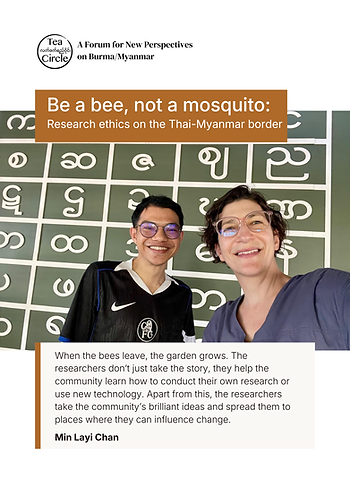
This article by Rosalie Metro, Associate Teaching Professor at the University of Missouri-Columbia, and Min Layi Chan, the Research Program Manager at TeacherFOCUS Education Consulting, offers practitioner insights on ethical and participatory research practices in conflict-affected contexts. The authors share principles they have learned facilitating participatory research, including co-creating research questions with community members, adapting consent processes to local cultural norms, and ensuring findings are translated, accessible, and returned to the communities that generated them.
The article addresses locally-informed ethics, including the role of the Community Ethics Advisory Board (CEAB) and the cultural dynamics of "voluntold" participation. The article explores the tension between academic rigor and data sensitivity in collaborative settings. Chan's bee-and-mosquito analogy offers a critique of extractive research practices, urging researchers to prioritize reciprocity and community benefit. The conversation also explores the pitfalls of collaborative research, including unequal labor burdens, the risk of suppressing inconvenient findings, and the challenge of preserving authentic local voices within academic writing conventions.
Citation: Metro, R. and Chan, M, L. (2026). Be a bee, not a mosquito: Research ethics on the Thai-Myanmar border. Tea Circle.